Bitcoin’s Evolution From "Fringe" to Portfolio Fundamental
A Tale of Two “Stores of Value”, generational gap and uncertainty

"A 2% allocation to Bitcoin funded from equities in a 50/50 portfolio would have resulted in a 20% higher Sharpe ratio compared to a standard portfolio."

Over the past decade, Bitcoin has transitioned from a niche digital experiment into a “unique risk/return driver” for modern portfolios. Recent data from early 2026 suggests that institutional adoption has matured, positioning Bitcoin as a strategic macro asset rather than a purely speculative one.
The Strategic Role: Diversification and Correlation
The primary argument for adding Bitcoin to a portfolio is its unique correlation profile.
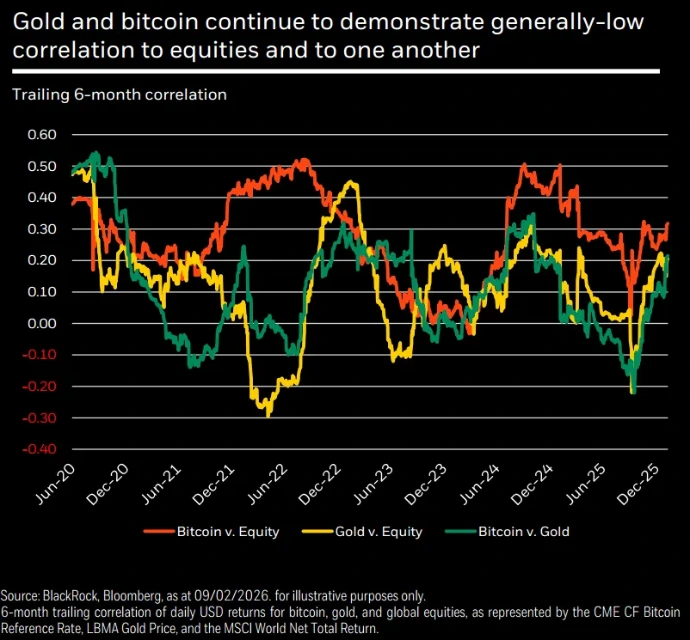
Bitcoin continues to demonstrate generally low correlation to global equities and gold.
While its correlation to stocks can be cyclical—often rising during periods of extreme market stress—its correlation to gold has remained mostly low and at times negative.
Even during peaks in equity-market correlation (such as late 2024), Bitcoin’s relationship with gold remained distinct, offering a “broadening of the toolkit” for diversifiers.
Performance: High Impact, Small Sizing
Historical data shows that Bitcoin has been the top-performing major asset class in many years (e.g., 1,375% in 2017 and 305% in 2020) but also the lowest in others (-74% in 2018 and -64% in 2022). Because of this volatility, professional managers emphasize that “a little goes a long way”.
Risk-Adjusted Returns: Over the last 10 years, a 2% allocation to Bitcoin funded from equities (in a 50/50 portfolio) would have resulted in a 20% higher Sharpe ratio compared to a standard portfolio.
Expected Risk: Adding that same 2% allocation only adds approximately 30 basis points (0.30%) of additional expected risk to the total portfolio.
Drawdowns: While Bitcoin is prone to sharp drawdowns, a small 2% allocation has historically had a negligible impact on the overall portfolio’s maximum drawdown (e.g., a -19.48% drawdown vs -19.37% for a starting portfolio).
Summary of the “2% Rule” (Illustrative):

Implementation for the (young) Belgian Investor
The investment landscape in Belgium has reached a fascinating crossroads where “digital gold” is outpacing traditional diversification for the younger generation. According to the BNP Paribas Fortis Invest Barometer (2025/2026), cryptocurrency has officially become the most popular asset class among Belgian investors aged 18–34, with 25% of this demographic holding digital assets. This figure significantly exceeds their adoption of individual shares or real estate funds (both at 19%). Data from the FSMA (2025) further underscores this trend, suggesting that over 40% of investors in their twenties and thirties now include crypto in their portfolios, often prioritizing the high-growth potential of Bitcoin over the steadier, albeit more predictable, nature of index funds.
However, while crypto currently holds the crown for popularity, Exchange-Traded Funds (ETFs) are the fastest-growing segment in terms of momentum. BlackRock’s 2025 “People & Money” report highlights that European ETF adoption is surging, with a 52% increase in ownership among the 25–34 age group. In Belgium specifically, the number of ETF investors has jumped by over 40% since 2022. This shift suggests a “maturing” of the young Belgian portfolio: many who started with speculative crypto trades are now looking to ETFs to build a more resilient core. Interestingly, the two worlds are merging; BlackRock’s data indicates that nearly half of prospective new ETF buyers are specifically interested in Crypto ETPs, seeking the volatility of Bitcoin within the regulated, secure framework of a traditional brokerage.
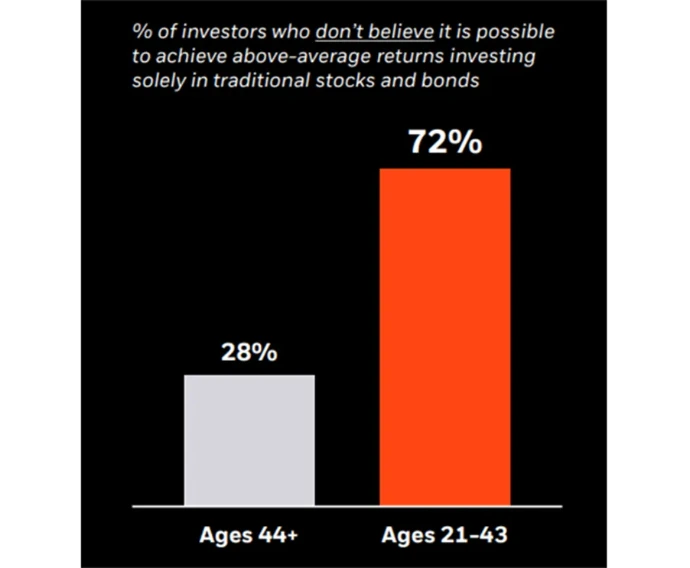
A recent Bank of America (BoA) Private Bank Study (2024) confirms this “generational canyon” in investment philosophy. As shown in the chart below, a staggering 72% of investors aged 21–43 no longer believe that a traditional portfolio of only stocks and bonds can deliver above-average returns. This is a complete reversal from the mindset of investors aged 44 and older, where only 28% share that skepticism. This lack of faith in the “60/40” portfolio is driving younger cohorts to treat alternative assets—including crypto, private equity, and real estate—not as speculative side bets, but as essential components of a modern growth strategy.
Source: 2024 Bank of America Private Bank Study of Wealthy Americans
For Belgian investors, moving from the theory of a 2% allocation to actual implementation also involves navigating a complex landscape of limited access, missing regulatory safeguards, and fiscal ambiguity.
Limited Access and Market Protection: Unlike traditional stocks and ETFs, very few Belgian retail banks offer direct crypto trading. Investors who venture into unregulated crypto exchanges lose the “Best Execution” protections that safeguard them in traditional markets.
The Fund Barrier: The Belgian regulator (FSMA) currently does not allow Bitcoin or other cryptocurrencies to be included in traditional investment funds. This creates a significant hurdle for the many Belgian clients who prefer to invest through diversified fund structures rather than managing individual assets.
The Fiscal Vacuum for ETPs: While products like the BlackRock Bitcoin ETP offer an efficient way to gain exposure, they currently sit in a “fiscal vacuum.” Without the specific rulings that professional managers have secured for physical gold ETCs for example, these products risk being classified as “fixed-income” assets for tax purposes. This could lead to a 30% tax (Reynders Tax) on gains, as opposed to the more favorable treatment often applied to direct holdings or gold-like instruments.
Bitcoin vs. Gold: A Tale of Two “Stores of Value”
While Bitcoin is frequently dubbed “digital gold,” the data from 2025 and 2026 reveals that these two assets play distinct, often complementary roles within a portfolio. Both are viewed as alternatives to fiat currencies in an era of fiscal uncertainty, but they respond to different market triggers.
In conclusion, Bitcoin serves as a potential return enhancer that, when sized correctly and rebalanced regularly, can improve the efficiency of a diversified portfolio without fundamentally changing its risk profile.
Rather than choosing one over the other, the most efficient portfolios in early 2026 often use both assets to broaden the “diversification toolkit”.
Sharpe Ratio Enhancement: Funding a 2% Bitcoin allocation from either equity or gold has historically improved the Sharpe ratio (risk-adjusted return) over a 10-year horizon.
Return Profile: Bitcoin offers the potential for “exceptional returns”—such as its 27,518% cumulative return from 2015-2025—which gold, with a 265% return in the same period, cannot match.
Volatility Buffer: Conversely, gold provides a stabilizing effect during “crypto winters” or sudden sharp drawdowns common to digital assets.