Leveraged ETFs: Adrenaline... Followed by Disappointment?
"In recent months, we have observed an increase in communications regarding leveraged ETFs, particularly on social media. This may be due to recent product launches and an underlying trend originating from the United States."

In recent months, we have observed an increase in communications regarding leveraged ETFs, particularly on social media. This may be due to recent product launches and an underlying trend originating from the United States.
Number of Leveraged ETFs
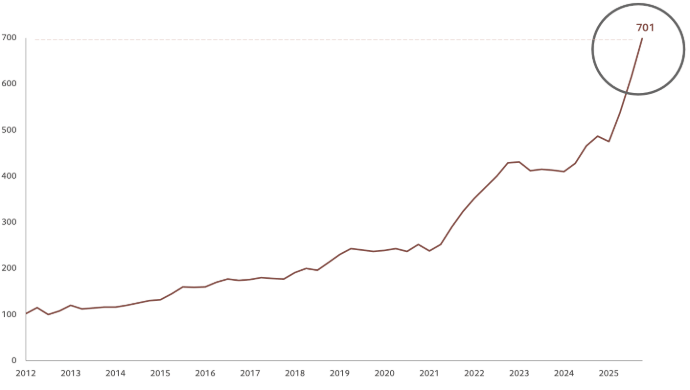
Source: BofA Global Investment Strategy, EPFR, Pictet Asset Management, 31 October 2025
As a reminder, a leveraged ETF aims to replicate indices—often popular ones—using a multiple (2x, 3x, etc.). To achieve this, the fund holds cash/collateral and utilizes derivative products (e.g., swaps) to multiply exposure until the desired leverage is reached.
It is necessary to qualify what may appear to be an implicit promise (i.e., multiplying the return of the standard index), as things can easily go south. At first glance, it might seem logical for an investor who expects long-term bull markets and has a reasonably long horizon to decide to amplify their performance. However, reality can prove to be quite different...
Indeed, various factors explain why the intended objective—which is often misunderstood—is not met. The primary reason lies in the daily reset of the leverage, which triggers a compounding effect on performance over time. In other words, and in very simplified terms, the leverage is “respected” over a one-day period, but deviations are likely beyond that.
Simplified Illustration
Let’s take an investor who, at market open, places €100 into ETF A (replicating the MSCI World) and €100 into ETF B (a 2x leveraged MSCI World ETF). The MSCI World rises +15% on day one and falls -12% on day two:

For illustrative purposes only; a simplified representation of daily leverage reset that does not account for other frictions such as product fees.
By the end of the second day, the position in ETF A has generated a cumulative performance of +1.2%. If the investor expected a performance of +2.4% from ETF B, they would be disappointed, as the return is actually negative (-1.2%).
In practice, the results of these products are highly dependent on the trajectory of the benchmark index and its volatility. In a strongly directional bull market (a relatively constant rise), returns can potentially be magnified; however, the opposite is also true. In a more volatile market or one struggling to maintain a clear upward trend, volatility creates an erosion effect (often called volatility decay), becoming the enemy of leverage.
How bad can this go? The Covid case: During Covid, one remembers how volatile oil prices showed, leading some leveraged ETFs to stop trading. It was the case of WisdomTree WTI Crude Oil 3x Daily Leveraged (3OIL) which, after an overnight 33% fall in oil prices, opened around 99% down, leading the swap counterparty to close the swap position and investors to incur massive losses. This example is not isolated; it happened with other products like leveraged ETFs exposed to the VIX, for instance.
Beyond compounding and volatility, it is worth noting that ETF costs can significantly add to the erosion effect. On one hand, the TER (Total Expense Ratio) of these products tends to be higher than “standard” ETFs. On the other hand, the less visible cost of leverage resulting from the use of derivatives can also weigh on performance.
For any investor, innovation and new products are generally good news, potentially offering relevant options to enhance portfolio construction. However, it is essential to fully understand any instrument and its underlying risks. In the case of leveraged ETFs, investors should specifically question the intended objective of such products and the appropriate holding period.